MHST 601: Analysis of Global Child and Adolescent Physical Activity using the Social Ecological Model
- jaxsloan
- Nov 3, 2023
- 5 min read

Updated: Sep 28, 2024
Childhood Obesity - a global phenomenon
The World Health Organization (WHO) defines the terms overweight and obesity as the accumulation of excessive body fat that can lead to long-term health issues. In 2016, over 340 million children and adolescents aged 5-19 were reported as being overweight or obese. An estimated 39 million children under the age of 5 were reported as overweight or obese in 2020 and this number is projected to grow (Obesity and Overweight, n.d.).
Childhood obesity is becoming increasingly prevalent in developing countries, especially in urban settings. In recent years, Africa’s obesity rates have increased by 24% and approximately 50% of 5-year-olds in Asia are overweight or obese (Obesity and Overweight, n.d.). This worldwide phenomenon has increased the incidence of childhood “psychiatric, psychological and psychosocial disorders” which often lead to poor health outcomes in adulthood (Di Cesare et al., 2019).
Many factors influence childhood obesity such as diet, genetics, stress and poor sleeping patterns (Di Cesare et al., 2019); however, the fundamental cause is linked to the increased consumption of sugary, high caloric foods and decreased physical activity (PA). According to Alvarez-Pitti et al., (2020) existing research suggests that PA participation benefits the wellbeing of children and adolescents by improving physical and mental health, brain and cognitive functioning, bone health as well as social and psychological development.

During my literature search on this topic, I came across a study by Hu, Donglin, et al., (2021), which comprehensively reviewed international literature that examines the factors that influence physical activity in school-aged children and adolescents, using the 5 levels of the Socioecological Model (SEM) that was adapted by McLeroy et al. (1988). The study reviewed 4134 international quantitative and qualitative studies on the subject. I will use these findings as a foundation for this post.
Analysis of PA using the SEM
The SEM is a multilevel conceptualization of health that emphasizes intrapersonal, interpersonal, organizational, environmental and public policy spheres of influence. The model examines the social, physical and political environments that impact behavior change (Scarneo et al., 2019). An illustration of the model is provided below:
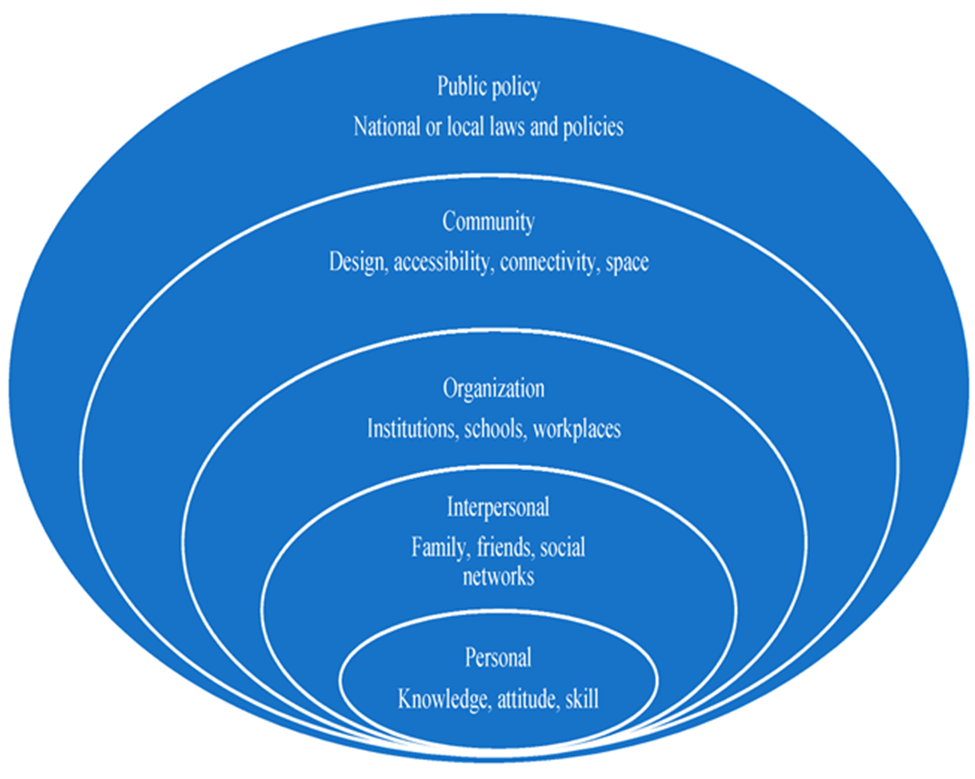
Figure 1. The social ecological model adapted from McLeroy, K.R., Bibeau, D., Steckler, A., and Glanz, K. (1988). An ecological perspective on health promotion programs.
What follows is a summary of Hu, Donglin et. al.’s key findings regarding the spheres of influence that impact PA rates in children and adolescents. (Note the summary highlights the dominant themes within their research; however, please note there are additional factors associated with each domain that are not captured here.)
Personal
Gender, self-concept (self efficacy, perceived health, physical self-perception, participation motives, perceived competence and enjoyment), age, ethnicity and body mass index are the major contributing factors within this category.
Typically, girls commence physical activities at higher levels than boys; however, they tend to spend less time participating in non-organized activities. By the age of 12, girls’ PA participation rates decline in comparison to their male counterparts.
Positive self-efficacy was observed in boys who participated in PA, whereas participating in PA added to girls’ self-efficacy by helping them overcome barriers.
Interpersonal
Adolescents with higher perceived social support from peer and family networks show higher levels of PA.
Girls who receive social support are often more physically active than their male peers; however, the authors noted that boys tend to have more social supports than girls overall.
Having physically active friends with a similar Body Mass Index has been shown to impact PA in all children and young adults.
A physically active parent/s correlates with the level of PA observed in their children/dependents.
Parental encouragement is another major determining factor under this category.

Organization and Community
Schools play an important role in providing organized PA and health promotion messaging to children from an early age.
PA programming in schools promotes moderate to vigorous PA participation in children and youth. When young people have the opportunity to participate in school sports they have a higher level of PA when compared to their lesser active counterparts.
Accessibility of facilities and safe neighborhoods are the primary influences within this domain.
Other barriers within this category include time constraints linked to home responsibilities and adjusting school times and increased use of video games, television and other electronic devices, typically linked to reduced facility accessibility and access to organized sports.
Public Policy
Research under this domain is limited; more in-depth analysis is required to understand how public policy can be framed to address issues at a strategic level. The authors noted the following:
Policies or practices could be implemented to improve facility accessibility, community safety and other barriers associated with low PA in children and youth.
Policy makers must advocate for public policy at the global level.
Criticisms of the SEM
Hu, Donglin et. al., criticize the SEM’s inability to showcase the interconnectedness between the spheres of influence that it presents. Weiner et al. (2012) agree and argue that although the SEM provides a framework for understanding multiple determinants of health, it fails to provide guidance on how to select interventions at different levels that produce (or could produce) complementary or synergistic effects.” Although I agree with these criticisms, I believe the SEM is a useful, easy-to-use tool for conceptualizing health and social issues.

Conclusion
The authors concluded with the following recommendations for improving child and adolescent PA:
Intrapersonal interventions should include gender and age-specific strategies. Focusing on self-concept in all genders would also be beneficial.
Interpersonal/organizational interventions should incorporate school-based and community-based strategies that leverage stakeholders such as parents, teachers and school administrators.
Facility accessibility and affordability, and community safety should be tackled at the public policy level. Future studies are needed that focus on this sphere of influence in more detail.
Focusing on this subject has been an interesting undertaking that introduced me to a variety of scholarly articles and research papers. My research has provided me with a deeper understanding of how the SEM can be applied to analyze determinants of health and spheres of influence in relation to PA rates in children and adolescents. I look forward to learning more about this and other multilevel approaches during my studies.
References
Alvarez-Pitti, J., Casajús-Mallén, J. A., Leis-Trabazo, R., Lucía, A., López de Lara, D., Moreno-Aznar, L. A., & Rodríguez-Martínez, G. (2020). Exercise as medicine in chronic diseases during childhood and adolescence. Anales de Pediatría (English Edition), 92(3), 173.e1-173.e8. https://doi.org/10.1016/j.anpede.2020.01.001
Bryan J. Weiner, Megan A. Lewis, Steven B. Clauser, Karyn B. Stitzenberg, In Search of Synergy: Strategies for Combining Interventions at Multiple Levels, JNCI Monographs, Volume 2012, Issue 44, May 2012, Pages 34–41, https://doi.org/10.1093/jncimonographs/lgs001
Chapter 1: Models and Frameworks | Principles of Community Engagement | ATSDR. (2018, December 6). https://www.atsdr.cdc.gov/communityengagement/pce_models.html#:~:text=The%20social%20ecological%20model%20conceptualizes%20health%20broadly%20and,mental%2C%20and%20social%20well-being%20%28World%20Health%20Organization%2C%201947%29
Di Cesare, M., Sorić, M., Bovet, P., Miranda, J. J., Bhutta, Z., Stevens, G. A., Laxmaiah, A., Kengne, A.-P., & Bentham, J. (2019). The epidemiological burden of obesity in childhood: a worldwide epidemic requiring urgent action. BMC Medicine, 17(1), 212. https://doi.org/10.1186/s12916-019-1449-8
Hu, Donglin, et al. (2021). “Factors That Influence Participation in Physical Activity in School-Aged Children and Adolescents: A Systematic Review from the Social Ecological Model Perspective.” International Journal of Environmental Research and Public Health, vol. 18, no. 6, Jan. 2021, p. 3147, https://doi.org/10.3390/ijerph18063147
McLeroy, K. R., Bibeau, D., Steckler, A., & Glanz, K. (1988). An ecological perspective on health promotion programs. Health education quarterly, 15(4), 351-377
Obesity and overweight. (n.d.). Who.int. Retrieved October 30, 2023, from https://www.who.int/news-room/fact-sheets/detail/obesity-and-overweight
Scarneo, S. E., Kerr, Z. Y., Kroshus, E., Register-Mihalik, J. K., Hosokawa, Y., Stearns, R. L., DiStefano, L. J., & Casa, D. J. (2019). The Socioecological Framework: A Multifaceted Approach to Preventing Sport-Related Deaths in High School Sports. Journal of Athletic Training, 54(4), 356–360. https://doi.org/10.4085/1062-6050-173-18
Obesity and overweight. (n.d.). Retrieved October 31, 2023, from https://www.who.int/news-room/fact-sheets/detail/obesity-and-overweight
Weiner, B. J., Lewis, M. A., Clauser, S. B., & Stitzenberg, K. B. (2012). In search of synergy: Strategies for combining interventions at multiple levels. Journal of the National Cancer Institute. Monographs, 2012(44), 34–41. https://doi.org/10.1093/jncimonographs/lgs001


Comments